Pronouns Usage Guide
Everyone uses pronouns. Even if we can not remember our school lessons, we easily remember pronouns. This guide should help anyone who may not remember that the pronouns THEY and THEM have been used to describe a person in the singular form.
8/25/20253 min read

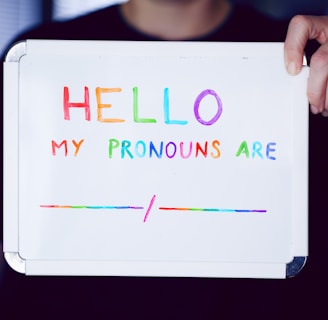
There are some situations where some people can get a little confused on pronouns. This may be when a person does not conform to a gender stereotype, or has used a particular gendered pronoun before and is now using another pronoun that better aligns with that person.
How to use Gendered Pronouns with Respect and Ally-ship
In Canada’s official languages, English and French, third-person singular pronouns are gendered.
It’s important to most people, whether they are cis, trans, non-binary, or gender diverse, to be acknowledged and respected in their gender.
Using the correct pronouns for people is like using the correct name: it’s a basic signal of respect. And for trans, non-binary, and gender diverse people, being referred to by the correct pronouns is a signal of affirmation and acceptance.
Being misgendered can be extremely hurtful for trans, non-binary, and gender diverse people, and correcting people on one’s pronouns or gender can often be exhausting and humiliating. Normalizing, sharing your own pronouns and asking for other people’s pronouns will make it less likely that anyone will be misgendered.
If you’re not sure how to use someone’s pronouns, just ask! People will appreciate that you want to learn to refer to them correctly.
Preferred Pronouns
The term “preferred pronouns” is misleading because it implies that a trans, non-binary, or gender diverse person’s pronouns are just a preference and that it might be acceptable to use other pronouns for them, which it is not.
Pronouns and How to Use Them
Pronouns: Words that can replace nouns – words referring to people, places, or things – in a sentence.
For example, we could say, “Has anyone seen my jacket? I left it on the table.” In this sentence, it is a pronoun referring to my jacket.
Personal pronouns are pronouns that refer to a person: Grammatically, pronouns are in the first, second, or third person depending on whether the speaker is referring to themselves, to the listener, or to another person.
First-Person Pronouns: When a person speaks about themselves e.g., I, me, my, myself; we, us, our, ourselves.
Second-Person Pronouns: When a person speaks about the person to whom they are speaking e.g., You, your, yours, yourself.
Third-Person Pronouns: When a person speaks about someone other than themselves or the person to whom they are speaking e.g., She, her, hers, herself; he, him, his, himself; they, them, their, themselves.
Commonly Used Pronouns
Feminine/Female related: Most women and girls are referred to by she/her/hers/herself pronouns, but not all people who use these pronouns are women and girls and not all women and girls use these pronouns.
Masculine/Male related: Most men and boys are referred to by he/him/his/himself pronouns, but not all people who use these pronouns are men and boys and not all men and boys use these pronouns.
Multiple people related: They/them/their/theirs/themselves pronouns are most often used when talking about multiple people who are neither the speaker nor the listener (the third person plural).
For example: “Alice and Jo left their jackets on the table.”
Plural pronouns as a single: They/them pronouns are sometimes used to refer to a single person when that person’s identity, gender, and/or pronouns are unknown or are the person’s chosen pronouns.
For example: “Someone left their jacket on the table.”
By extension, some people, particularly non-binary people, use they/them pronouns because they/them pronouns are an existing gender-neutral way to refer to a person.
When people use multiple pronoun sets, they can be referred to using any of the pronouns they use.
For Example: If a person uses, she/they or him/they this is referred to as multiple pronoun set.
This may be more common for people who may identify as the sex assigned at birth, but their gender identity as non binary, transgender, queer gender non conforming, etc. “Thomas wants his book back. They said they will pick it up later.”
Another example, might be a person using she/they pronouns. “She left her jacket on the table” or “They left their jacket on the table.” Or “She left their jacket on the table”
It’s important to make an effort to use all pronoun sets for a person who uses multiple pronoun sets (i.e., not just the ones that are easier for you to use because you’re used to it).
Some people may also use one pronoun set over another even if they use multiple pronouns, and for others the pronouns they use can change depending on the context.
Neo-pronouns
Neo-pronouns area not overly common at this point. This is more for reference and awareness, however, if you do come across them, you will already be aware of them.
Some people use personal pronouns other than she, he, or they in order to better express their gender. These are called neo-pronouns.
Some neo-pronouns are used by more people than others – in fact, some people create their own pronouns that only they use.
It’s okay to be unsure of how to use neo-pronouns, especially if you haven’t practised using them before. It can be difficult to figure out the grammar of pronouns that you’re unfamiliar with.
For further information on neo-pronouns or pronouns in general visit EGALE at www.egale.ca
Copyright 2026 -The Rainbow Crosswalk
The Rainbow Crosswalk Logos were created by Kasie https://www.facebook.com/kasie.larose/
We acknowledge that we live on the land that is the traditional unceded and unsurrendered territory of the Wolastoqiyik Peoples. This territory is covered by the “Treaties of Peace and Friendship” which Peoples first signed with the British Crown in 1725. The treaties do not deal with surrender of lands and resources, but in fact, recognize Wolastoqiyik title and establish the rules for what is an ongoing relationship between nations.